Welcome to the Thrive Beyond 50 Superfoods Series
Walk through the aisles of any grocery store today, and you’ll be bombarded with products claiming to be the next miracle food. Superfood powders, exotic berries from halfway around the world, expensive supplements, and trendy diet products all promise to improve your health. The truth is, many of the most powerful foods for healthy aging have been with us all along.
Over the next seven articles, we’ll take a closer look at seven of my favorite “superfoods” for adults over 50. These aren’t exotic or difficult to find. In fact, most of them can be found at your local grocery store or farmers’ market. More importantly, they are foods backed by nutrition science and supported by decades of research on healthy aging.
Each article will explore what makes these foods so unique, the nutrients they provide, how they support the body from a functional medicine perspective, and practical ways to include them in your everyday meals. My goal isn’t simply to tell you what to eat. I want you to understand why these foods matter, because knowledge is one of the most powerful tools we have for taking control of our health.
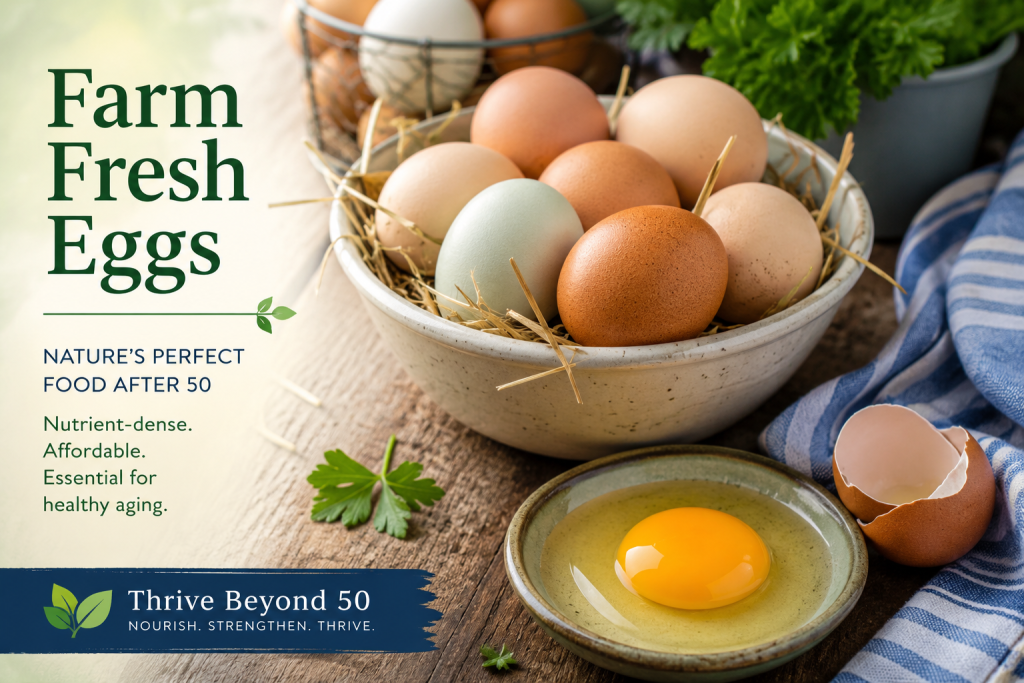
We’ll begin with one of the most misunderstood foods in nutrition: the humble farm-fresh egg. For years, eggs were unfairly criticized because of their cholesterol content. Today, we know they are among the most nutrient-dense, affordable, and versatile foods available. Packed with high-quality protein, choline, vitamins, minerals, and antioxidants that support muscle, brain, and eye health, eggs are an excellent place to begin our journey toward healthier aging.
So, let’s crack the shell on decades of nutrition myths and discover why farm-fresh eggs deserve a place on your plate.

Why Farm Fresh Eggs Deserve a Place on Your Plate After 50
For decades, eggs have been one of the most misunderstood foods in nutrition. At various points, they have been praised as a nutritional powerhouse and criticized because of their cholesterol content. As nutrition science has evolved, our understanding of eggs has become far more nuanced. Today, for most healthy adults, eggs are recognized as a nutrient-dense food that can play an important role in a balanced diet.
If I were asked to recommend one affordable, versatile, and highly nutritious food for adults over the age of 50, farm-fresh eggs would be near the top of my list.
One of the biggest nutritional challenges that accompanies aging is the gradual loss of muscle mass and strength, a process known as sarcopenia. Beginning around the fifth decade of life, adults naturally lose muscle unless they actively work to preserve it through resistance exercise and adequate protein intake. Maintaining muscle is not simply about appearance. Muscle supports balance, mobility, bone health, metabolism, and the ability to perform everyday activities independently.
Eggs provide an excellent source of high-quality protein. Unlike many plant proteins, eggs contain all nine essential amino acids in proportions that closely match the body’s needs. This makes them a complete protein capable of supporting muscle protein synthesis, tissue repair, and recovery after physical activity. For older adults, whose muscles may respond less efficiently to dietary protein, regularly including high-quality protein sources becomes even more important.
Eggs are also one of nature’s most concentrated packages of essential nutrients. They provide vitamin B12, riboflavin, selenium, phosphorus, iodine, and vitamin A; nutrients involved in energy metabolism, thyroid function, immune health, and healthy vision. Many adults over 50 struggle to obtain enough vitamin B12 because absorption declines with age. Including foods naturally rich in this vitamin can help support neurological function and red blood cell production.
Perhaps one of the most overlooked nutrients found in egg yolks is choline. Choline serves as a building block for acetylcholine, one of the brain’s primary neurotransmitters involved in memory, learning, and muscle function. It also contributes to healthy cell membranes and plays an important role in liver health by supporting normal fat metabolism. Despite its importance, many adults fail to consume adequate amounts of choline each day. Eggs remain one of the richest dietary sources available.
Egg yolks also contain the carotenoids lutein and zeaxanthin. These antioxidant compounds accumulate in the retina and have been associated with supporting eye health as we age. Although no single food can prevent age-related eye diseases, diets rich in these nutrients have been linked to a lower risk of certain age-related vision changes. For individuals over 50, protecting eye health becomes increasingly important for maintaining independence and quality of life.
Farm-fresh eggs may offer additional advantages beyond the already impressive nutrient profile of conventional eggs. The exact nutritional differences depend on the hens’ diet and living conditions, but pasture-raised hens often produce eggs with somewhat higher levels of omega-3 fatty acids, vitamin E, and certain carotenoids. Their yolks are frequently darker because the birds consume grasses, insects, and other natural foods containing plant pigments. While these differences can vary considerably, many people appreciate the flavor, texture, and freshness of locally produced eggs.
Another reason I encourage adults over 50 to include eggs in their diets is their remarkable versatility. A breakfast centered around eggs is often far more satisfying than one built around refined cereals, pastries, or sugary breakfast bars. Pair scrambled eggs with spinach, mushrooms, tomatoes, and a side of fresh fruit, and you have a meal that provides protein, fiber, vitamins, and healthy fats without the dramatic rise and fall in blood sugar that often follows highly processed breakfast foods. This combination can help promote satiety and make it easier to avoid midmorning cravings.
Of course, eggs are not a perfect food, nor are they appropriate for everyone. Individuals with egg allergies should avoid them, and people with certain medical conditions should discuss their dietary choices with their healthcare provider. For the general population, however, current evidence suggests that moderate egg consumption can fit within a healthy dietary pattern. The overall quality of the diet, including fruits, vegetables, legumes, whole grains, nuts, and healthy fats, remains far more important than focusing on a single food.
Healthy aging is built meal by meal. It is the result of consistently choosing foods that nourish the body, preserve muscle, support the brain, and provide the nutrients required to stay active and independent. Farm-fresh eggs accomplish all of those goals in one remarkably simple package.
If you are looking for one food to add to your weekly grocery list, farm-fresh eggs deserve serious consideration. They are nutritious, delicious, and economical, and they are among the easiest ways to support healthy aging from the inside out.
From the Functional Medicine Perspective
Functional medicine asks a simple question: “What nutrients does the body require to function optimally?” Eggs answer that question remarkably well.
Every cell in the human body depends on proteins to repair tissue, enzymes to drive metabolism, fats to build healthy cell membranes, vitamins to fuel biochemical reactions, and minerals to support everything from thyroid hormone production to immune function. Eggs provide many of these raw materials in one of the most bioavailable forms found in nature.
-Choline supports healthy liver function and is essential for producing acetylcholine, a neurotransmitter involved in memory, learning, and muscle contraction.
-The amino acid leucine serves as one of the primary signals that stimulates muscle protein synthesis, making eggs particularly valuable for preserving muscle mass as we age.
-Lutein and zeaxanthin help protect the retina from oxidative stress, while selenium supports antioxidant enzymes that defend our cells against free-radical damage.
Rather than viewing eggs simply as a source of protein, I view them as one of nature’s most efficient nutrient delivery systems.
Dr. Edwards’ Take
When I think about the healthiest older adults I’ve met throughout my career, I don’t picture people chasing the latest nutrition trend or spending hundreds of dollars each month on supplements. I picture people eating simple, nourishing foods that their grandparents would have recognized. Farm-fresh eggs are one of those foods. They’re proof that some of the best nutrition doesn’t come in a bottle or a flashy package…sometimes it arrives in a simple shell.